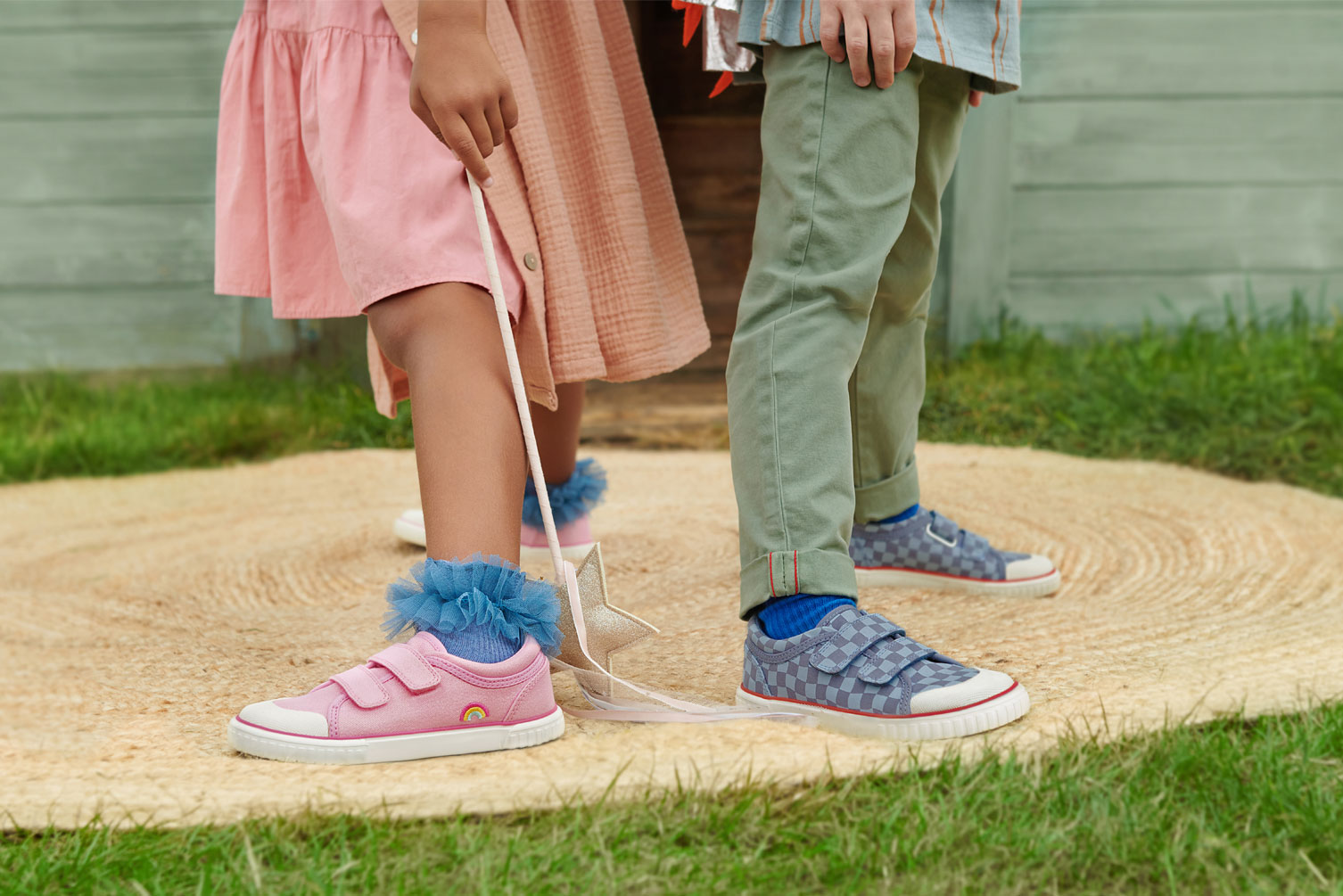
Your child’s feet are fascinating and adorable. Small, podgy and underdeveloped at birth, they gradually form more bones, shape an arch and start to take their natural shape as your little one approaches school age.
Understanding the shape of your child’s foot is integral to finding the right style of shoe for comfort and maximum support where it matters.
We often hear people talk about children having extremely wide feet, and finding flexible straps, designs and manufacturers who cater for them. Less frequently, we hear talk of children who have particularly narrow feet, even though this is just as common.
So, in this blog, we focus on narrow feet, how to measure your child’s foot to understand their width and the best styles to look for if your child has narrow feet.
Start-Rite shoes come in multi-width fittings, from a D fitting which is the narrowest, through to a H fitting which is the widest. The average and most common width fitting is an F, so a D fit would be classed as a narrow foot - meaning that your child’s feet are naturally narrower than most.
There are a variety of ways you can measure your child’s foot at home and children tend to find it a fun and interesting experience, so long as you can persuade energetic little ones to stand still for long enough!
Since speed can often be of the essence here, many parents use our partner SizeWise’s digital measuring tool. This allows you to use your phone’s camera to quickly and easily assess your child’s foot size without needing to measure by hand.
Prefer the traditional method? You can easily measure your child’s feet with a measuring tape or paper measuring gauge, then use our Size Calculator to find the corresponding shoe size and width fitting.
Top tip! When measuring, make sure your child is standing upright and that the tape measure is snug around the widest part of the foot when it’s flat on the ground.
Not feeling confident about measuring at home? Don’t worry. Your local high street likely has a professional fitting service available in an independent shoe shop, where a skilled fitter can put your mind at rest and help you to locate shoes in the best width fitting for your child.
Generally, if your child has a narrow heel, they will also have a narrow foot, as the width tends to be consistent along the length of the foot. A professional fitter will also look at the height of your child’s instep, as this can also have an impact on which shoe style will be best for the foot.
Shallow styles with more foot coverage are often the best choice for narrow feet, ensuring that shoes offer adequate support, fit the narrow width and stay snugly on the foot. However, every child is different, and a little trial and error may be needed to find the ideal style for your little one.
There are a few ways that you can tell if your child’s shoe is too wide, which may indicate narrow feet. These include:
If you spot signs that your child’s shoes don’t fit quite right, it’s time to measure. Make sure to measure length as well as width, even if you’re sure the shoes are too wide - because a shoe that is simply too big overall will also likely be wider than necessary. If that’s the case, then your child might not need a narrow fit - just a smaller overall shoe size.
Having a narrow foot is perfectly natural and nothing to worry about in and of itself. However, getting the right style and size of shoe is vital to support your child’s unique feet - and our site can help you to filter options by width fitting to save you time.
On top of that, we’ve also curated a list of our Start-Rite styles that are best for a narrow foot.
In girls’ shoes, we have:
In boys’ styles, we have:
All of these styles are ideal for narrow feet, featuring secure fastenings to ensure an adaptable fit.
If your child has narrow feet, it’s nothing to worry about. With a little care and consideration when choosing shoe styles, you can ensure a comfortable, hard-wearing fit that keeps your little ones protected and happy all day long. And if you have any doubts, speaking to a professional fitter can help.
Author: Vista, published 27-04-2026.