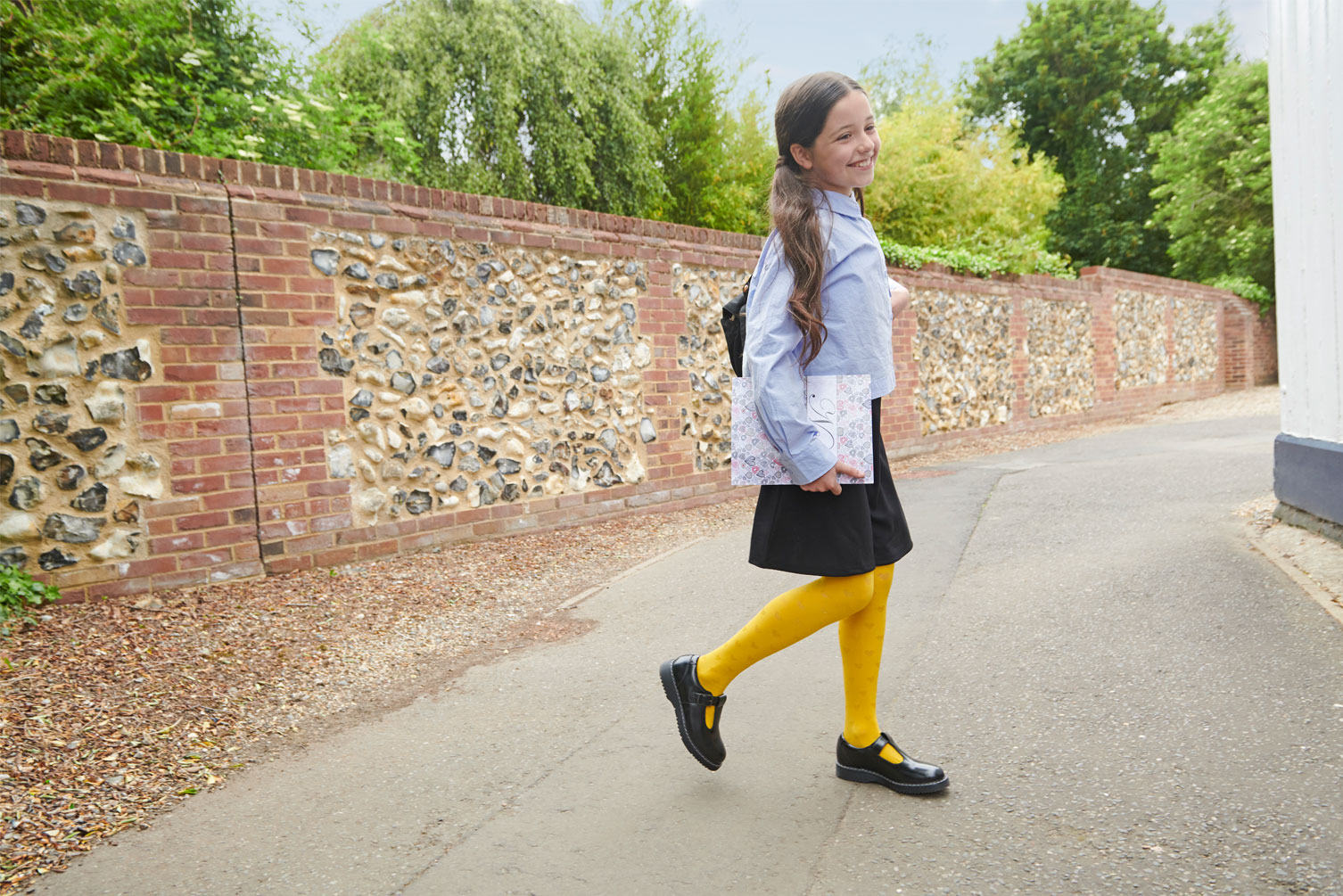
Here at Start Rite, we’ve been making children's shoes since 1792 - that’s over 225 years spent engineering the perfect fit. Over this time, we’ve researched, developed, tried and tested our school shoes on thousands of children to ensure the most precise of fittings.
Using pioneering new research into how children move, we’ve re-engineered our shoes so that they work seamlessly with the foot, enabling children to move with comfort and confidence.
We’ve found that something as small as a few millimetres here or there has the power to alter how comfortably a shoe fits. That’s why our shoes are available in multi-width fittings for little feet of all shapes and sizes. Narrow, regular, wide and extra-wide fittings ensure each and every child can enjoy complete comfort and confidence throughout the school day.
Our school shoes are specifically developed for the shape and different growing stages of a child’s foot, and fit is regularly checked and perfected on our team of over 1,000 children. Following this, every new shoe is trialled in real life for over three months by our real-life kids.
At Start Rite, we provide shoes in four different width fittings:
Narrow fit school shoes are perfect for children with slightly narrower feet than usual. Ensuring children with narrow feet have correctly fitted shoes is important, as shoes that are too wide may cause blisters, calluses and corns, as well as foot and leg pain.
When your child tries on a shoe and you feel like there is too much extra room inside of the shoe, this might be the first sign that your child has narrow feet. There may be extra space in the front of the shoes (on the side of the toes) and around the ankles, and the heel may slide out of the shoe as they walk.
Children with narrow feet need to wear shoes with width fitting ‘E’. We offer a wide range of narrow fit school shoes for both boys and girls.
Shop our fit E school shoes here.
Wider fit school shoes are for children with slightly wider feet that need extra space. Forcing wider feet into narrow or regular fit shoes can have a serious impact on developing feet, leading to foot, leg, back pain and injuries. The pressure from tightly fitting shoes can damage delicate feet and bones, causing ingrown toenails, cramping, nerve damage and even hammertoe.
Wide fit school shoes are for kids who naturally have wider feet, or little ones who may have conditions such as overlapping or pinched toes and require extra wiggle room with a wider toe box.
Help to prevent any of these problems by ensuring your child has well-fitting school shoes with plenty of room for movement. Our wide fit school shoes in fit ‘G’ have been expertly designed to offer comfort, stability and security for wider feet that require more room.
We offer plenty of school shoes with the perfect wide fit, from sporty rip-tapes to stylish Mary Janes, and everything in between.
Shop our fit G school shoes here.
Our extra wide fit school shoes in fit ‘H’ are ideal for kids who need extra room for a comfortable fit. They offer complete confidence from the classroom to the playground, preventing any unnecessary discomfort, strain, or injuries.
While you may have previously found it difficult to shop for extra wide fit shoes, many of our school shoes are available in an H fit, in a range of designs.
Shop our fit H school shoes here.
If your child is none of the above, chances are they’re a straight-up regular fit and require a pair of school shoes in fit ‘F’.
With styles to suit every taste and available in sizes small S 7 to a large size L 11, you're bound to find the perfect pair.
Shop our fit F school shoes here.
Finding the right fit for your child can be tricky when you’re unsure of what to look for. Luckily, there are steps you can take to make finding that perfect fit easier – whether you’re shopping online or in-store. .
One of the difficulties in shopping online is that you don’t get the opportunity to try before you buy – but that doesn’t mean you have to abandon all hope of a good fit. Instead, you can make the shopping experience smoother by preparing ahead of time.
The best way to increase your chances of a good fit when shopping for school shoes online is to measure your child’s feet within a week or two of school starting – or when you realise they need new school shoes. You can then compare their measurements to size guides online.
Why the timing? Children’s feet grow fast, which means they’ll often grow out of well-made shoes before they wear them out. Measuring in July could mean you buy shoes that are then too small in September, so it’s best to wait and get the most out of their new shoes.
If you’re worried about measuring wrong, don’t be. Measuring your child for school shoes is really simple, and there are different methods available so you can find the one that works best for you.
Measuring before you shop is a great idea even if you’re shopping in person, as it gives you a way to narrow down your search from the get-go. But you also have the advantage of being able to check the fit of your child’s school shoes before you buy.
Here's how to do it:
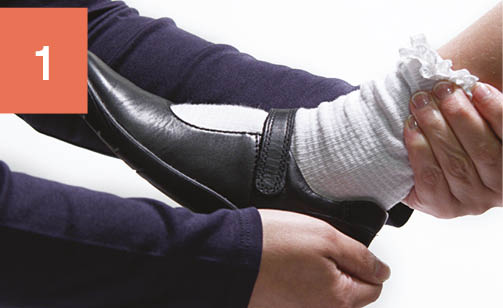
Heel Grip – Have your child sit on a stool or chair in the shop. Lift one of their feet up and cup the heel with one hand. Then hold the ankle in your other hand. Try to gently pull the heel down a few times – this will show you how well the shoe is gripping your child’s heel. Repeat this on their other foot.
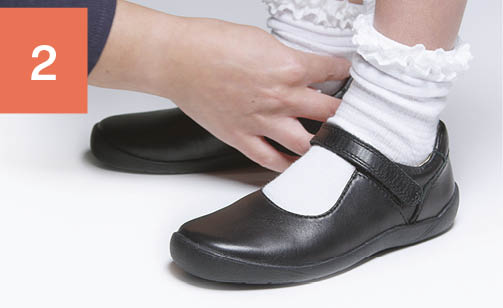
Top of the Shoe – With your child standing, run your fingertips around the top of the shoe. Check if there are any gaps between the sides of the shoes and your child’s foot. This is especially important around the heel, as gaps like this could mean your child’s heel slips out of the shoe when walking.
Ankle – For shoes with non-padded collars, gently feel for the sides of your child’s ankle bone. These are the two hard lumps on either side of your child’s foot, between the bottom of the legs and the base of the heel. If the shoe touches here, it could rub. Shoes with padded collars are designed to touch the ankle bones and are cushioned to avoid this rubbing.
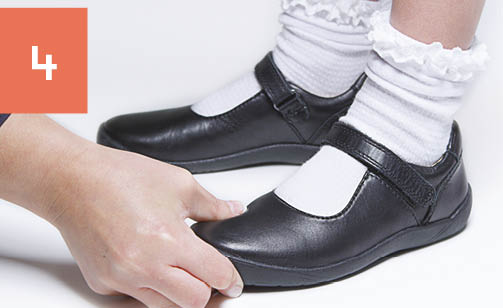
Length – At the tip of the toe box, gently feel for the end of your child’s longest toe. All of our shoes have “growing room” built in, and you should be able to feel that small gap easily. If their toes are pressing against the end of the shoe, that’s a sign they need a larger size.
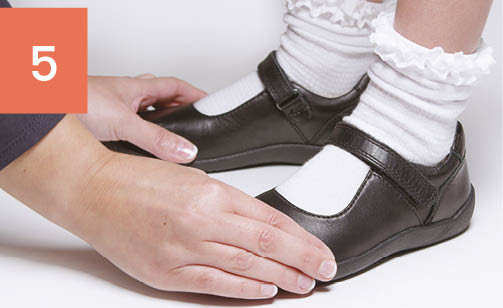
Width – Forming your hand into a “crab claw” shape, feel along the sides of the shoe. If the shoe is a good fit, you shouldn’t feel bulging or any pressure against the sides anywhere along the length of the foot.
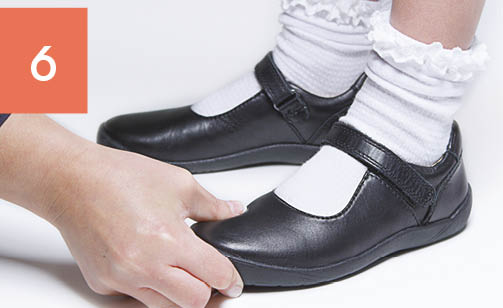
The upper – Run your fingers across the upper over the toe box. This should produce a slight, shallow movement in the leather or synthetic leather – if the shoe fits. If the shoe is too narrow, the material of the upper will be stretched taut and won’t move at all. Too wide, and the material will dip much more and be very flexible.
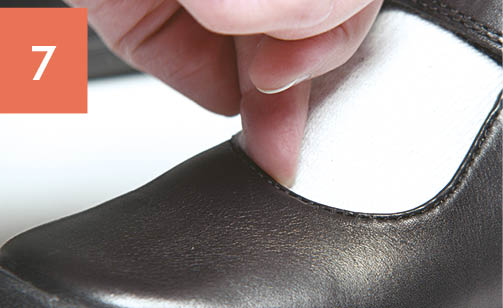
Depth – For low cut shoes like Mary Janes, run your finger under the section of upper that covers the toes. Your finger should feel snug but not cramped or loose. Any bulging of the foot or large gaps between the upper and the foot signifies the wrong fit.
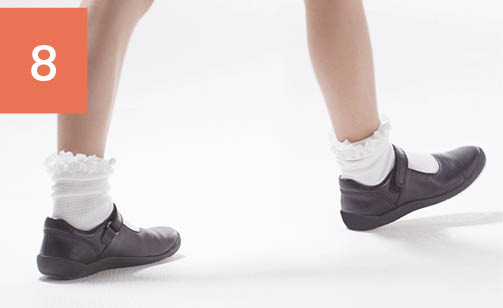
Walking – Now it’s time for the fun part: letting your child walk around to try out their new shoes. This part is fairly simple. Watch out for any difficulties or odd walking movements, or problems like the heel slipping or gaping at the sides. Allow a few minutes for walking around to ensure you get a good test walk.
Confused? Check out the video below to see this method in action.
For further guidance, we have plenty of articles and resources to help you with school shoe shopping and getting the right fit for your child.